Nonlinear Models of Biological Systems (4)

Deprecation warning

This website is now archived. Please check out the new website for Centre for Intelligent Systems which includes both A-Lab Control Systems Research lab and Re:creation XR lab.

However, the Dynamic System Model Database can still be used and may be updated in the future.

Mathematical Model for a Single-Link Flexible Joint Robot

Model description: 

The dynamical equations governing the behavior of a single-link flexible joint robot are traditionally obtained from Lagrangian dynamics considerations. Let $q$ denote the angular position of the link (see attached image) of half length $L$ and mass $m$ and let $q_m$ be the angular position of the motor. The differential equations governing the controlled motions are given by

$$\begin{align*} \tau &= D_m\ddot{q}_m + D_m\dot{q}_m + K_S(q_m-q) \\ 0 &= D\ddot{q} + B\dot{q} + mgL\sin{q}+K_S(q-q_m), \end{align*}$$

where $D$ denotes the inertia of the link, $D_m$ denotes the motor inertia; the flexible joint stiffness coefficient is $K_S$ and the motor viscous damping and the link viscous damping are $B_m$ and $B$, respectively. The gravitational acceleration is denoted by $g$.

Define $\rho^2 = 1 / K_S$, which is not to be taken as a small constant related to singular perturbation techniques. The state variables were defined as the motor's angular position $x_1 = q_m$, the corresponding angular velocity $x_2 = dq_m/dt$, the elastic force $x_3 = K_S(q - q_m)$ and $X_4 := (dq/dt- dq_m/dt)/\rho$. The state variable representation is then obtained as

$$\begin{align*} \dot{x}_1 &= x_2 \\ \dot{x}_2 &=-a_5x_2 + a_1x_3 + a_1u \\ \dot{x}_3 &= x_4/\rho \\ \dot{x}_4 &= [-a_2a_3\sin{\rho^2x_3 + x_1}-a_4x_3 - a_7x_2 - a_6\rho x_4 - a_1u]/\rho \end{align*}$$

with $a_1=1/D_m$, $a_2 = 1/D$, $a_3 = mgL$, $a_4=a_1+a_2$, $a_5 = B_m/D_m$, $a_6=B/D$, $a_7 = a_6-a_5$, $a=\tau.$

Type: 

Form: 

Time domain: 

Linearity: 

Publication details: 

TitleDynamical Feedback Control of Robotic Manipulators with Joint Flexibility
Publication TypeMagazine Article
Year of Publication1992
AuthorsSira-Ramirez, Hebertt, Ahmad Shaheen, and Zribi Mohamed
MagazineIEEE Transactions on Systems, Man and Cybernetics
Volume22
Issue Number4
Pagination736-747
Date Published06/1992
ISSN0018-9472
Accession Number4277471
Keywordsdifferential equations, dynamics, feedback, observability, position control, robots, stability, variable structure systems
AbstractDynamic feedback control strategies are proposed for the asymptotic stabilization and asymptotic output tracking problems, associated with the operation of flexible joint manipulators. Smooth dynamical linearizing feedback controllers, as well as dynamical sliding mode regulators, are derived within the context of M. Fliess's (1989) generalized observability canonical form (GOCF). The GOCF is obtained by means of a state elimination procedure, carried out on the system of differential equations describing the manipulator dynamics. The remarkable feature of this new approach lies in the fact that a truly effective smoothing of the sliding mode controlled responses is possible while substantially reducing the chattering in the control input torque. Simulation examples are given that illustrate the performance of the proposed controllers
DOI10.1109/21.156586

Nonlinear benchmark system

Model description: 

$$\begin{align*} x_1(t+1) &=\left(\dfrac{x_1(t)}{1+x_1^2(t)}+1\right)\sin{x_2(t)} \\ x_2(t+1) &=x_2(t)\cos{x_2(t)}+x_1(t)e^{-((x_1^2(t)+x_2^2(t))/8} + \dfrac{u^3(t)}{1+u^2(t)+0.5\cos{x_1(t)+x_2(t)}} \\ y(t) &=\dfrac{x_1(t)}{1+0.5\sin{x_2(t)}}+\dfrac{x_2(t)}{1+0.5\sin{x_1(t)}}+e(t), \end{align*}$$

where $e(t)$ is the noise term, has a variance of 0.1.

Type: 

Form: 

Model order: 

2

Time domain: 

Linearity: 

Publication details: 

TitleNonlinear system identification via direct weight optimization
Publication TypeJournal Article
Year of Publication2005
AuthorsRoll, Jacob, Nazin Alexander, and Ljung Lennart
JournalAutomatica
Volume41
Pagination475 - 490
Date Published01/2005
ISSN0005-1098
URLhttp://dx.doi.org/10.1016/j.automatica.2004.11.010

A nonlinear ARX (NARX) system

Model description: 

$$\begin{align*} y(t)&=\begin{bmatrix}0.1 & -0.1 & 0.25 & 0.5 \end{bmatrix} \varphi (t) +\\ &+ \frac{L}{2}(\|\varphi (t)\|^2 - 2(max\{\|\varphi(t)\|^2, 1\} -1) +\\ &+ 2(max\{\|\varphi(t)\|^2, 2\} - 2) - (max\{\|\varphi(t)\|^2, 3\} -3)) + e(t), \end{align*} $$

where

$\varphi(t)=\begin{bmatrix} y(t-1) & y(t-2) & u(t-1) & u(t-2)\end{bmatrix}^{\mathrm T}$

$L = 0.1$

$e(t) \in N(0, 0.01)$, i.e. $\sigma = 0.1$.

Type: 

Form: 

Time domain: 

Linearity: 

Publication details: 

TitleNonlinear system identification via direct weight optimization
Publication TypeJournal Article
Year of Publication2005
AuthorsRoll, Jacob, Nazin Alexander, and Ljung Lennart
JournalAutomatica
Volume41
Pagination475 - 490
Date Published01/2005
ISSN0005-1098
URLhttp://dx.doi.org/10.1016/j.automatica.2004.11.010

Bilinear system of non-minimum phase

Model description: 

$$\begin{align*} y(t) &= y(t-1) + u(t-1) + 1.3u(t-2) + 0.3u(t-1)y(t-1) \\ &+0.5u(t-2)y(t-2)+e(t)/\Delta, \end{align*}$$

where $e(t)$ is normal school white noise signal with covariance 0.1.

Type: 

Form: 

Model order: 

2

Time domain: 

Publication details: 

TitleGeneralized Predictive Control for a Class Of Bilinear Systems
Publication TypeConference Paper
Year of Publication1970
AuthorsLiu, Guizhi, and Li and Ping
Conference NameControl, Automation, Robotics and Vision
Date Published2006
AbstractA new generalized predictive control algorithm for a kind of input-output bilinear system is proposed in the paper (BGPC). The algorithm combines bilinear and linear terms of I/O bilinear system, and constitutes an ARIMA model analogous to linear systems. Using optimization predictive information fully, the algorithm carries out multi-step predictions by recursive approximation. The heavy computation of generic nonlinear optimization is avoided with control law of analytical form being used to the non-minimum phase bilinear systems. Simulation results show the effectiveness of the algorithm and the performance of the algorithm is better than linear generalized predictive control (LGPC). Key words: bilinear systems; bilinear generalized predictive control (BGPC); recursive approaches; non-minimum phase systems; analytical control laws
DOI10.1109/ICARCV.2006.345181

Nonlinear Models of Biological Systems (4)

Model description: 

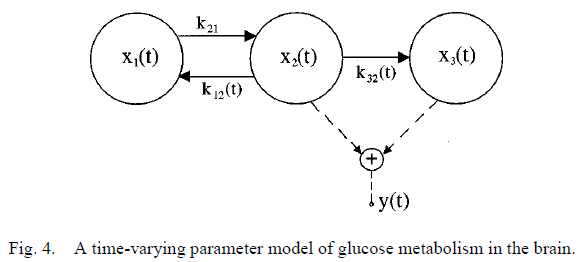
The model we discuss here has been proposed to study glucose metabolism in the brain from positron emission tomography (PET) [$^{18}$F]-Fluoro-Deoxy-Glucose($^{18}$F-FDG) data K. Schmidt, G. Mies, and L. Sokoloff, “Model of kinetic behavior of deoxyglucose in heterogeneous tissues in brain: A reinterpretation of the significance of parameters fitted to homogeneous tissue models,” J. Cereb. Blood Flow Metab., vol. 11, pp. 10–24, 1991. The model is shown in Fig. 4. It is a two compartment model with two time-varying parameters which account for brain tissue heterogeneity.

The system-experiment model is

$$\begin{align*} \dot{x}_2(t) &= k_{21}u(t) - (k_{12} + k_{32}(t))x_2(t) \\ \dot{x}_3(t) &= k_{32}(t)x_2(t)\\ y_1(t) &= x_2(t) + x_3(t)\\ \end{align*}$$

System parameters are presented in the table below.

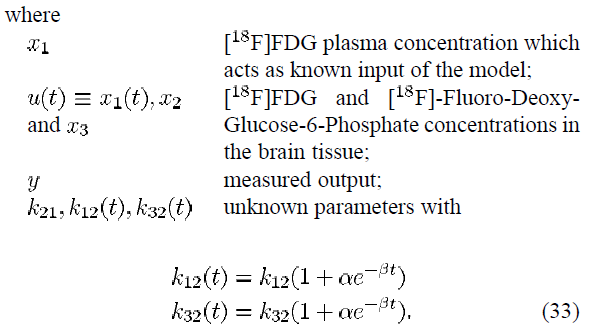
$x_1$ [$^{18}$F]FDG plasma concentration which acts as known input of the model;
$u(t) \equiv x_1(t),x_2 and x_3$ [$^{18}$F]FDG and [$^{18}$F]-Fluoro-Deoxy-Glucose-6-Phosphate concentrations in the brain tissue;
$y$ measured output;
$k_{21},k_{12}(t),k_{32}(t)$ unknown parameters with: \begin{align} k_{12}(t) = k_{12}(1 + \alpha\epsilon^{-\beta t}) \\ k_{32}(t) = k_{32}(1 + \alpha\epsilon^{-\beta t}). \end{align}

Type: 

Form: 

Model order: 

2

Time domain: 

Linearity: 

Attachment: 

Publication details: 

TitleGlobal identifiability of nonlinear models of biological systems
Publication TypeJournal Article
Year of Publication2001
AuthorsAudoly, S., Bellu G., D'Angio L., Saccomani M.P., and Cobelli C.
JournalIEEE Transactions on Biomedical Engineering
Volume48
Pagination55-65
Date PublishedJan
ISSN0018-9294
Keywordsa priori global identifiability, algebra, algorithm, Algorithm design and analysis, Algorithms, Biological, Biological system modeling, biological system models, Biological systems, Biology computing, characteristic set, computer algebra techniques, differential algebra, Glucose, Humans, Insulin, Models, nonlinear dynamic models, Nonlinear dynamical systems, Nonlinear Dynamics, Nonlinear equations, nonlinear models, parameter estimation, Pharmacokinetics, physiological models, physiological systems, solution uniqueness, Testing, Time varying systems, time-varying parameters, zero initial conditions
AbstractA prerequisite for well-posedness of parameter estimation of biological and physiological systems is a priori global identifiability, a property which concerns uniqueness of the solution for the unknown model parameters. Assessing a priori global identifiability is particularly difficult for nonlinear dynamic models. Various approaches have been proposed in the literature but no solution exists in the general case. Here, the authors present a new algorithm for testing global identifiability of nonlinear dynamic models, based on differential algebra. The characteristic set associated to the dynamic equations is calculated in an efficient way and computer algebra techniques are used to solve the resulting set of nonlinear algebraic equations. The algorithm is capable of handling many features arising in biological system models, including zero initial conditions and time-varying parameters. Examples of usage of the algorithm for analyzing a priori global identifiability of nonlinear models of biological and physiological systems are presented.
DOI10.1109/10.900248

Pages